ADLC: The Agentic Development Lifecycle for Reliable AI Agents
Why AI agents that work perfectly in testing fail in production, and how the Agentic Development Lifecycle gives you a structured path to agents that actually hold up.
ADLC: The Agentic Development Lifecycle for Reliable AI Agents
Why AI agents that work perfectly in testing fail in production, and how ADLC gives you a structured path to agents that actually hold up.
Introduction
I have built automation frameworks that worked perfectly on 200 curated test cases and fell apart the moment real users got hold of them. The edge cases no one anticipated. The inputs that were perfectly reasonable but outside what we tested. The failures that were subtle and silent rather than loud and obvious.
AI agents have this problem at a much larger scale. They do not throw exceptions when they fail. They return a confident, plausible-sounding wrong answer. The failure mode is invisible until it is not.
ADLC, the Agentic Development Lifecycle, is the structured approach to building AI agents that hold up in the real world. It applies the same discipline that made SDLC valuable for traditional software, then adds the layers that probabilistic, reasoning-based systems actually need.
What Is ADLC?
ADLC is a framework for designing, building, testing, deploying, and continuously improving AI agents.
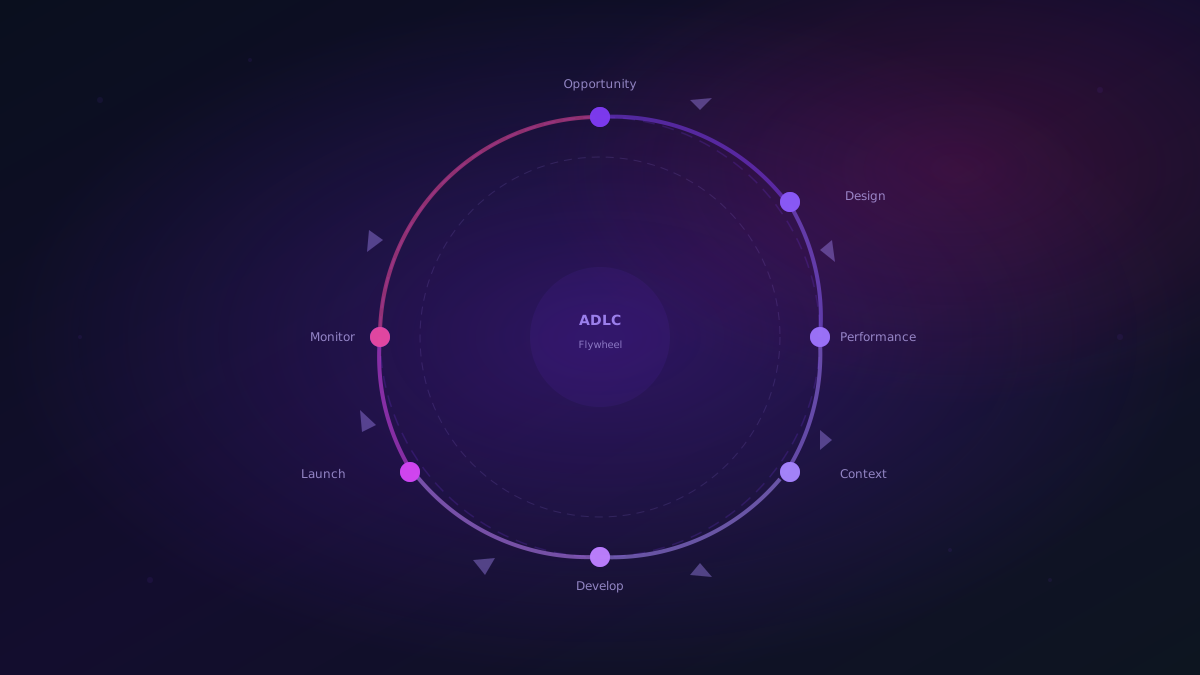
The key word is "continuously." Traditional software has releases and bug fixes. Agents have a flywheel: real usage reveals new failure patterns, those patterns improve your evaluation suite, better evals guide experiments, and experiments improve the agent. The cycle never stops.
ADLC is built for three realities that SDLC was not designed for:
- Probabilistic output: The same input can produce different outputs on different runs. Pass/fail unit tests do not capture this.
- Subtle failure modes: An agent that answers incorrectly with high confidence is harder to detect than a function that throws an error.
- Continuous drift: As the world changes and user inputs evolve, what worked at launch gradually degrades without active intervention.
SDLC vs ADLC: What Changes
| Dimension | SDLC | ADLC |
|---|---|---|
| Output nature | Deterministic | Probabilistic |
| Testing approach | Unit tests with clear pass/fail | Behavioral evals with scores and tolerances |
| Planning | Heavy upfront design | Light design, heavy iterative tuning |
| Failure mode | Exception thrown, immediately visible | Wrong answer delivered confidently, subtle |
| Governance | Code reviews and deployment gates | Real-time automated oversight with human checkpoints |
| Improvement model | Bug fix releases | Observe, evaluate, tune, repeat flywheel |
The shift is not incremental. An agent built with pure SDLC thinking will be unreliable in production regardless of how capable the underlying model is.
The 7 Phases of ADLC
Phase 1: Opportunity
Before writing a line of code, define the problem precisely. Which workflow are you replacing or augmenting? Who has the problem today and how often? What does success look like in measurable terms?
Agents fail most often because the problem definition was vague. "Help users with support tickets" is not an opportunity definition. "Reduce Level 1 support resolution time from 4 hours to 30 minutes for account access issues" is.
Key questions:
- Who has the problem and what does their current workflow look like?
- What outcome would constitute success, and how do you measure it?
- Is this a task where a wrong answer is recoverable, or does it require high-confidence thresholds?
Phase 2: Design
Design the agent's scope and boundaries before designing its capabilities. An agent without clear boundaries will attempt tasks it was never qualified to handle.
Decisions to make here:
- What actions can the agent take? What is explicitly out of scope?
- When should it escalate to a human rather than attempt an answer?
- What does the expected interaction flow look like?
- Which tools, APIs, or knowledge bases does it need access to?
Tight scope is not a limitation. It is a reliability feature.
Phase 3: Performance Targets
Define what "good" looks like before you build. This is the step most teams skip, and it is why agents ship without anyone agreeing on whether they actually work.
Performance targets should include:
- Accuracy threshold: What percentage of tasks must the agent complete correctly?
- Confidence calibration: How often does the agent express confidence correctly vs incorrectly?
- Latency bounds: What response time is acceptable under normal and peak load?
- Failure boundaries: What types of failures are acceptable versus unacceptable?
These targets become the acceptance criteria for your evaluation suite.
Phase 4: Context Engineering
Agents are only as good as the context they operate with. This phase is about assembling and structuring everything the agent needs to do its job well.
Context engineering includes:
- Curating the knowledge base or retrieval corpus
- Designing the system prompt and agent instructions
- Building few-shot examples that represent the real range of inputs
- Defining tool schemas and how results should be interpreted
This is often the highest-leverage phase for quality improvement. A well-structured prompt with strong examples outperforms a larger model with a poor one.
Phase 5: Develop and Evaluate
Build the agent and evaluate it against the performance targets from Phase 3. Critically, evaluation is not just testing on your training examples. It requires:
- Golden test sets: Curated inputs with verified correct outputs.
- Edge case coverage: Adversarial inputs, ambiguous queries, and out-of-scope requests.
- Regression suites: Tests that ensure new changes do not break previously working behavior.
- Human review on a sample: Automated scores do not replace human judgment on a subset of cases.
Your evaluation suite is your test coverage. A weak eval suite means you are shipping blind.
Phase 6: Launch
Agents should not go from zero to 100 percent of traffic at launch. Gradual rollout is not just good practice, it is a reliability requirement for systems with probabilistic behavior.
A responsible launch includes:
- Shadow mode running: the agent processes requests without acting on them, outputs reviewed by humans
- Small percentage rollout with monitoring dashboards live from day one
- Human checkpoints for high-stakes actions before full automation
- Feedback mechanisms for users to flag wrong or harmful outputs immediately
Phase 7: Monitor and Improve
After launch, the ADLC flywheel starts. This is where ongoing improvement happens:
- Observe: Collect real usage traces, latency metrics, and user feedback.
- Identify failures: Surface patterns in failures and brittleness on specific input types.
- Enhance evals: Feed newly discovered failure patterns back into the evaluation suite.
- Experiment: Test prompt changes, retrieval improvements, or model updates against improved evals.
- Ship: Deploy updates grounded in measured eval gains.
Repeat. The team that runs this flywheel fastest builds the most reliable agent.
Three Pillars Across All Phases
Governance
Rules that keep the agent within safe boundaries. Policy enforcement (what the agent is allowed to do), access controls (which data and tools it can reach), and audit trails (what it did and why). Governance is not a compliance checkbox. It is what prevents agents from taking unrecoverable actions.
Evaluation (Evals)
The single most important investment in any agent project. Your evaluation suite is your test coverage equivalent. The more comprehensive and representative your evals, the more confidently you can ship changes. Teams that treat evals as an afterthought ship agents they cannot trust.
Observability
The ability to see inside an agent's decisions. Reasoning traces (what did the agent consider at each step), KPI dashboards (is accuracy holding over time), and incident detection (alerting when performance drops). Without observability, failures are invisible until users find them.
Applying ADLC in Mobile QA Engineering
In my work on mobile quality engineering, I apply ADLC thinking to every agent I build for test automation, defect triage, or CI pipeline orchestration.
A test orchestration agent, for example:
- Opportunity: Reduce manual test selection time before each release.
- Design: The agent selects tests based on code diff and risk scoring. It does not modify test code or trigger deployments.
- Performance targets: Test selection must include 100 percent of tests covering changed modules. False negative rate under 2 percent.
- Context: Access to git diff, test coverage maps, and historical failure data.
- Evals: 300 historical release diffs with verified correct test selections.
- Launch: Shadow mode for 4 weeks, comparing agent selections to human selections before going live.
- Monitor: Track false negative rate per release. Feed misses back to evals weekly.
This discipline is the difference between an agent that becomes a production tool and one that gets switched off after the first bad release.
Takeaways
- AI agents fail in production not because the model is bad, but because there is no lifecycle governing how they are built and maintained.
- ADLC applies SDLC discipline to the unique challenges of probabilistic, reasoning-based systems.
- The 7 phases: Opportunity, Design, Performance, Context, Develop, Launch, Monitor and Improve.
- The flywheel is the core mechanism: real usage feeds better evals, better evals guide better experiments, better experiments improve the agent.
- Evaluation suites are the highest-leverage investment in agent reliability.
- Governance and observability are not optional, they are what make production agents trustworthy.
If you are building agents for production use, ADLC is not overhead. It is the minimum viable process for shipping something that actually works.