Building Scalable Mobile Automation Frameworks
Learn how to design and implement mobile automation frameworks that scale with your team and product growth.
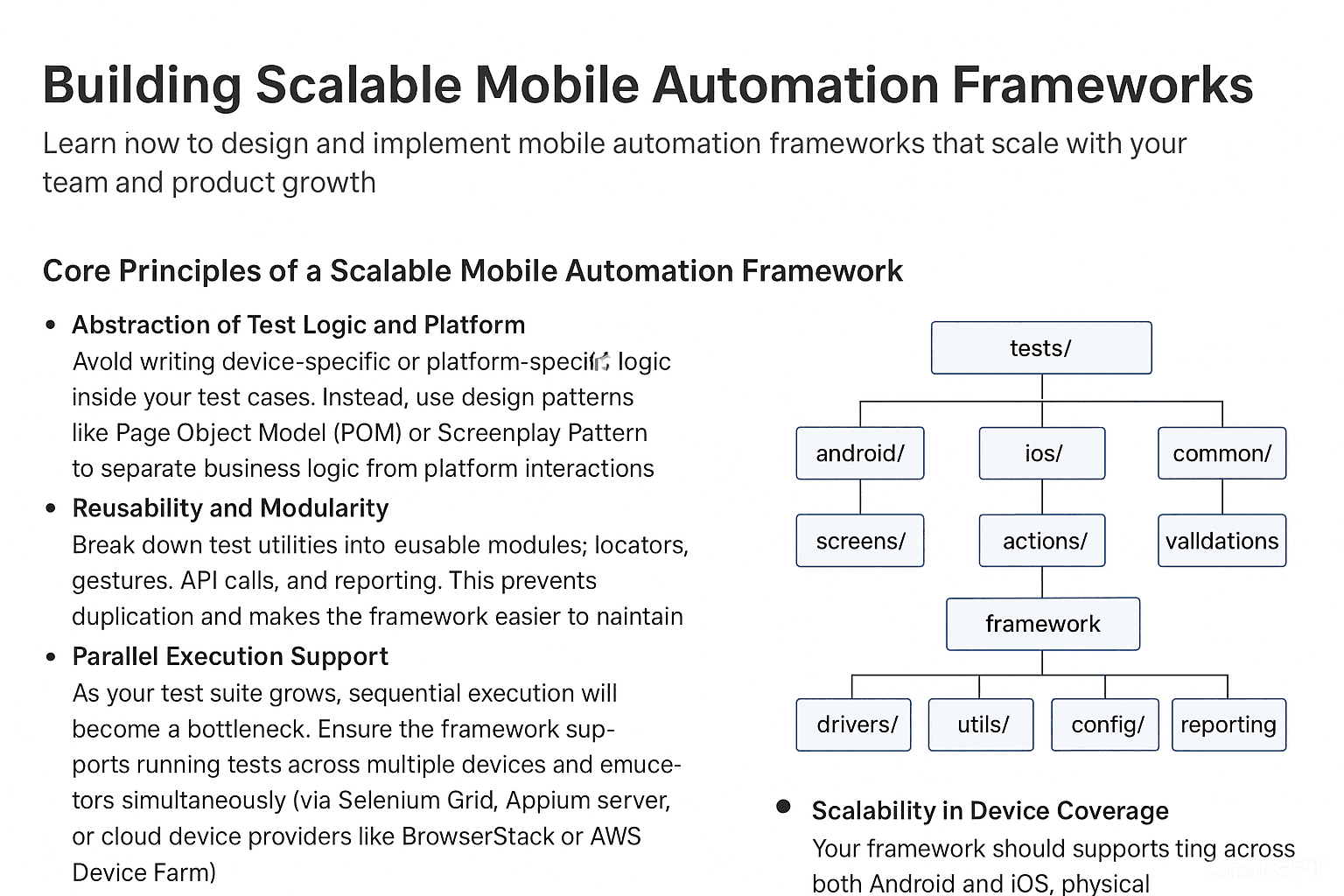
Building Scalable Mobile Automation Frameworks
Learn how to design and implement mobile automation frameworks that scale with your team and product growth.
Introduction
Mobile applications are no longer “nice-to-have.” They are the primary touchpoint for millions of users worldwide. From fintech to e-commerce, users expect apps to be fast, reliable, and intuitive. For engineering and QA teams, this means one thing: quality cannot be compromised.
But ensuring high-quality mobile apps is not easy. Devices vary by OS, screen size, hardware, and even network conditions. Testing manually across this landscape is time-consuming and error-prone. That’s why automation frameworks have become the backbone of modern QA.
The challenge, however, is not just building any automation framework,it’s building one that can scale as your product grows, your team expands, and your release cycles accelerate. In this post, we’ll explore the principles, architecture, and best practices for creating scalable mobile automation frameworks.
Why Scalability Matters in Mobile Test Automation
Early in a product’s lifecycle, you might get by with a handful of Appium scripts or XCUITest cases. But as your user base grows and features multiply, test automation must keep pace. Without scalability, you’ll face:
- Slower Feedback Loops: Tests take too long to run, delaying releases.
- Flaky Tests: Poorly structured scripts lead to inconsistent results.
- Maintenance Overhead: Adding or updating tests becomes painful.
- Team Bottlenecks: Multiple engineers cannot contribute efficiently.
Scalability ensures that your automation framework doesn’t just solve today’s problems but also anticipates tomorrow’s challenges.
Core Principles of a Scalable Mobile Automation Framework
Abstraction of Test Logic and Platform
Avoid writing device-specific or platform-specific logic inside your test cases. Instead, use design patterns like Page Object Model (POM) or Screenplay Pattern to separate business logic from platform interactions.
Reusability and Modularity
Break down test utilities into reusable modules: locators, gestures, API calls, and reporting. This prevents duplication and makes the framework easier to maintain.
Parallel Execution Support
As your test suite grows, sequential execution will become a bottleneck. Ensure the framework supports running tests across multiple devices and emulators simultaneously (Selenium Grid, Appium Server, or cloud providers like BrowserStack / AWS Device Farm).
CI/CD Integration
Automation should fit seamlessly into the release pipeline. Every code commit should trigger tests, providing feedback early in the cycle.
Scalability in Device Coverage
Your framework should support testing across both Android and iOS, physical devices and emulators, and low-end as well as high-end devices.
Framework Architecture: A Scalable Blueprint
Here’s a high-level structure you can adopt:
tests/
  ├── android/
  ├── ios/
  ├── common/
  │    ├── screens/
  │    ├── actions/
  │    └── validations/
framework/
  ├── drivers/
  ├── utils/
  ├── config/
  └── reporting/
- Tests Layer: Platform-specific and shared scenarios.
- Screens Layer: Page Objects / Screenplay actors for each screen.
- Actions & Validations: Shared gestures (swipe, scroll) and assertions.
- Drivers: Session management for Appium / Espresso / XCUITest.
- Utils: Logging, data generation, file helpers.
- Config: Centralized environment + capability management.
- Reporting: Allure, Extent, or custom dashboards.
Choosing the Right Tools
A scalable framework isn’t tied to one tool,it adapts. Common choices:
- Appium: Cross-platform, great for black-box testing.
- Espresso (Android) / XCUITest (iOS): Fast, reliable, good for white-box or performance-sensitive checks.
- Detox: Ideal for React Native and hybrid flows.
Recommendation: Use Appium for cross-platform breadth; augment with Espresso/XCUITest where speed or deeper integration is required.
Key Features to Build In
Cross-Platform Support
Write once, run on both Android and iOS where feasible. Use conditional driver factories + capability abstraction to manage platform differences.
Data-Driven Testing
Separate test data from test logic (JSON/CSV/external providers) to increase flexibility and reduce duplication.
Test Orchestration
Leverage TestNG / JUnit (or Jest/Mocha for JS-based stacks) to group, parameterize, and parallelize suites.
Retry & Flaky Test Handling
Implement intelligent retry for transient failures. Always capture screenshots, logs, and device vitals on failure.
Scalable Device Farm Setup
Adopt cloud device labs early to avoid local bottlenecks and broaden coverage (network types, OS versions, hardware tiers).
Best Practices for Scaling
Start Small, Scale Gradually – Begin with core flows (login, checkout, search), then expand risk-based.
Prioritize Stability Over Quantity – A stable 200-test suite beats 1,000 flaky scripts.
Version Control & Code Reviews – Treat test code as production code. Enforce PR reviews and style guidelines.
Monitoring & Reporting – Surface results via dashboards / Slack / Jira so failures become actionable quickly.
Invest in Training – Enable developers and QA engineers to co-own and evolve the framework.
Common Pitfalls to Avoid
- Mixing business logic with automation code.
- Ignoring iOS while focusing only on Android (or vice versa).
- Over-relying on emulators,missing real-device fragmentation issues.
- No ownership model,tests decay without accountability.
Real-World Example: Scaling at a Fintech Startup
At a fintech company, we began with ~12 Appium tests (login + money transfer) on a single Jenkins agent. As usage exploded:
- Introduced parallel execution (Selenium Grid + multiple Appium nodes).
- Added Espresso to measure low-level performance (e.g., keyboard latency).
- Expanded coverage using BrowserStack to target budget Android devices (core market segment).
- Integrated Allure dashboards for transparent nightly regression visibility.
Outcome: Release confidence improved, regression cycles dropped from 3 days to a few hours, and QA shifted from a bottleneck to an enabler.
Conclusion
Building a scalable mobile automation framework isn’t about the flashiest tooling,it’s about designing for evolution. By emphasizing abstraction, modularity, parallelism, and CI/CD integration, you create a living system that scales with product and team growth.
The payoff: Faster releases, fewer escaped defects, happier users, and a QA organization viewed as a strategic accelerator,not a cost center.
If you’re starting your journey: start simple, think extensible, and keep iterating.