Shift-Left Testing: A Practical Guide
Practical strategies for bringing testing earlier into the SDLC to accelerate feedback and improve quality.
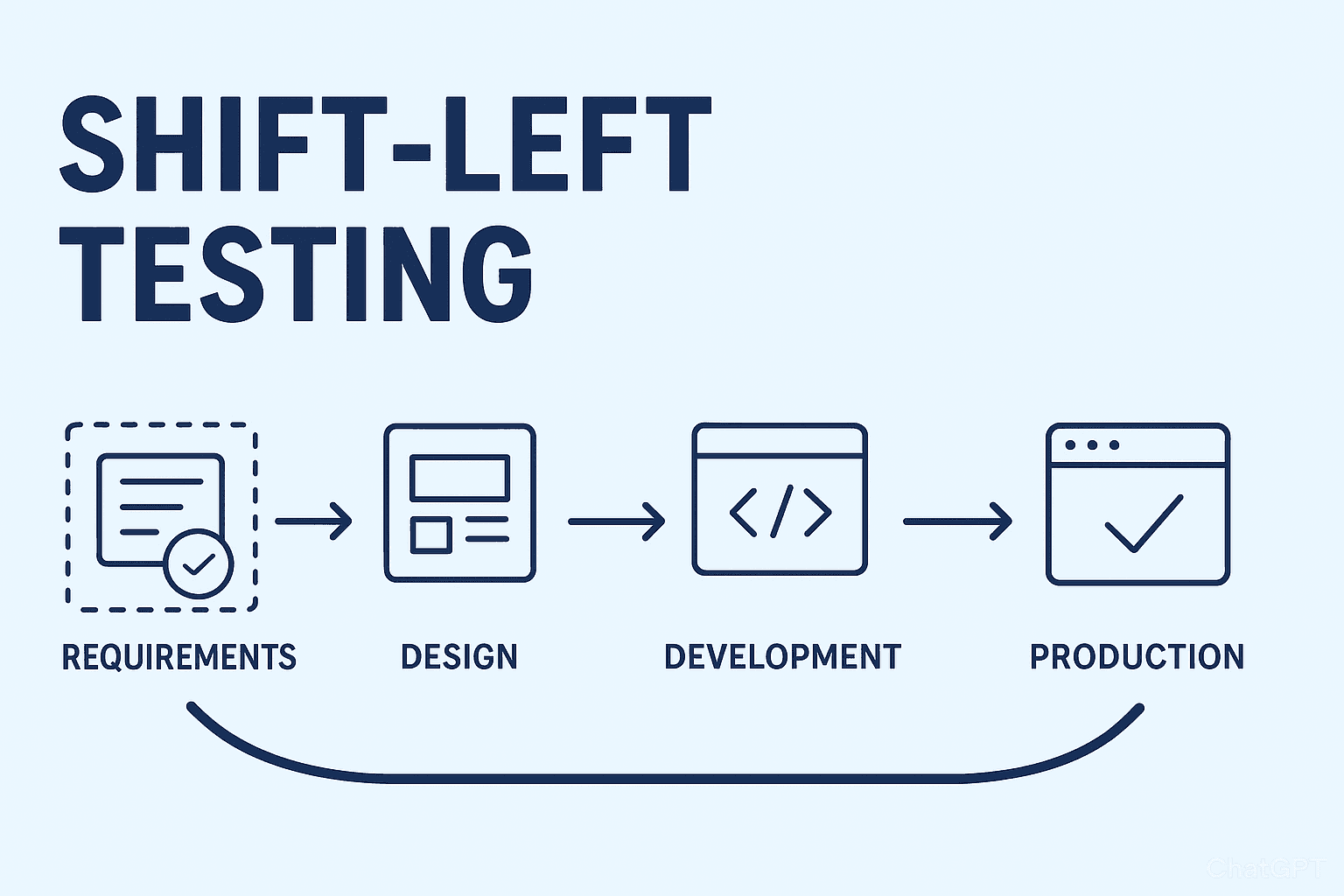
Shift-Left Testing: A Practical Guide
Practical strategies for implementing shift-left testing practices in your development workflow.
Introduction
In today’s fast-paced software delivery landscape, releasing quickly without compromising quality is a constant challenge. Traditional testing often occurs at the end of the development cycle, which means defects are discovered late,when they’re most expensive to fix.
Shift-Left Testing flips this approach by moving testing activities earlier (“to the left”) in the software development lifecycle (SDLC). This practice enables teams to detect issues sooner, reduce rework, and deliver higher-quality software faster.
In this guide, we’ll explore what shift-left testing is, why it matters, and practical strategies to adopt it effectively in your workflow.
What is Shift-Left Testing?
Shift-left testing is a quality engineering approach that encourages testing activities to begin early in the SDLC,ideally during requirements gathering and design. Instead of leaving testing until after development is complete, teams continuously test as code evolves.
Key principles include:
- Testing starts as soon as requirements are defined.
- Developers and testers collaborate closely.
- Automation is central to continuous validation.
- Quality is owned by the entire team,not just QA.
Why Shift-Left Matters
- Faster Feedback: Early detection shortens the feedback loop and prevents defect propagation.
- Reduced Costs: Fixing a defect in production can cost up to 100x more than fixing it in design.
- Improved Collaboration: Product, Dev, and QA align earlier on intent and acceptance criteria.
- Higher Quality Releases: Continuous validation reduces last-minute surprises.
Core Strategies to Implement Shift-Left Testing
1. Involve QA in Requirement Discussions
Bring testers into requirement and design sessions. Their perspective uncovers edge cases, ambiguity, and risk early.
✅ Tip: Use ATDD or BDD to convert requirements into shared, testable examples.
2. Embrace Test-Driven Development (TDD)
TDD ensures unit tests are written before implementation. This encourages modular design and creates a living regression safety net.
Benefits:
- Higher code coverage.
- Fewer logical defects.
- Faster debugging (fail fast at the function level).
3. Automate Early and Continuously
Don’t wait for a “stabilized feature” to begin automation. Automate as features evolve.
Prioritize:
- Unit tests (fast, foundational).
- API/service tests (contract and integration).
- Lightweight integration tests.
⚡ Pro Tip: Follow the Test Pyramid,optimize for many unit tests, fewer API tests, and minimal but meaningful end-to-end UI flows.
4. Continuous Integration (CI) with Quality Gates
Every commit triggers a pipeline that validates build integrity and quality metrics.
Typical stages:
- Install & build.
- Linting & static analysis.
- Unit + API test execution.
- Coverage & threshold enforcement.
Fail early if any gate is breached.
5. Static Testing Practices
Static analysis catches defects before execution. Integrate tools like ESLint, SonarQube, Checkstyle, or Semgrep.
Use cases:
- Security linting.
- Code smell detection.
- Enforcing architectural boundaries.
6. Adopt Service Virtualization
Blockers arise when dependent services, third-party APIs, or data sources aren’t ready. Service virtualization (e.g., WireMock, MockServer) simulates dependencies so testing starts immediately.
7. Shift Security Left (DevSecOps)
Bake security into the pipeline,don’t defer to a late-stage pen test.
Integrate:
- Dependency scanning (OWASP Dependency-Check, Snyk).
- SAST (static application security testing).
- DAST (dynamic testing in ephemeral environments).
Practical Example Workflow
- Requirement Review: Product + Dev + QA refine user story + acceptance criteria.
- Test Design: QA drafts high-level scenarios; Dev writes TDD skeletons.
- Development: Feature coded with unit tests & mocks/virtualized services.
- Automation Commit: Unit + API tests pushed alongside feature code.
- CI Execution: Pipeline runs build, lint, tests, security scans.
- Immediate Feedback: Failures reported within minutes to the author.
Common Challenges & How to Overcome Them
| Challenge | Problem | Solution |
|---|---|---|
| Cultural Resistance | Devs see testing as “QA’s job” | Promote shared ownership & pair on tests |
| Tooling Overload | Fragmented tools confuse adoption | Start with essentials; standardize gradually |
| Flaky Tests | Undermines trust in automation | Isolate root causes; quarantine & stabilize |
| Environment Gaps | Missing dependencies delay testing | Use containers + service virtualization |
| Slow Pipelines | Feedback loop too long | Parallelize, cache dependencies, prune UI tests |
Metrics for Success
Track leading & lagging indicators to validate impact:
- Defect Detection Rate (DDR): % of defects caught pre-release.
- Mean Time to Detect (MTTD): Average time from commit to defect discovery.
- Build Success Rate: Stability across mainline branches.
- Coverage Quality: Not just %,correlate risk-based coverage with escaped defects.
- Change Failure Rate: Lower post-deployment incidents indicate earlier quality.
Conclusion
Shift-left testing is more than a tactical shift,it’s a cultural and architectural evolution. By moving validation earlier, teams minimize rework, accelerate delivery, and build trust in their release pipeline.
You don’t need to adopt everything at once. Start with early QA collaboration or adding unit test enforcement in CI, then layer in service virtualization, quality gates, and security scanning.
Takeaway: The earlier you test, the better your software,and your feedback loops,will become.